
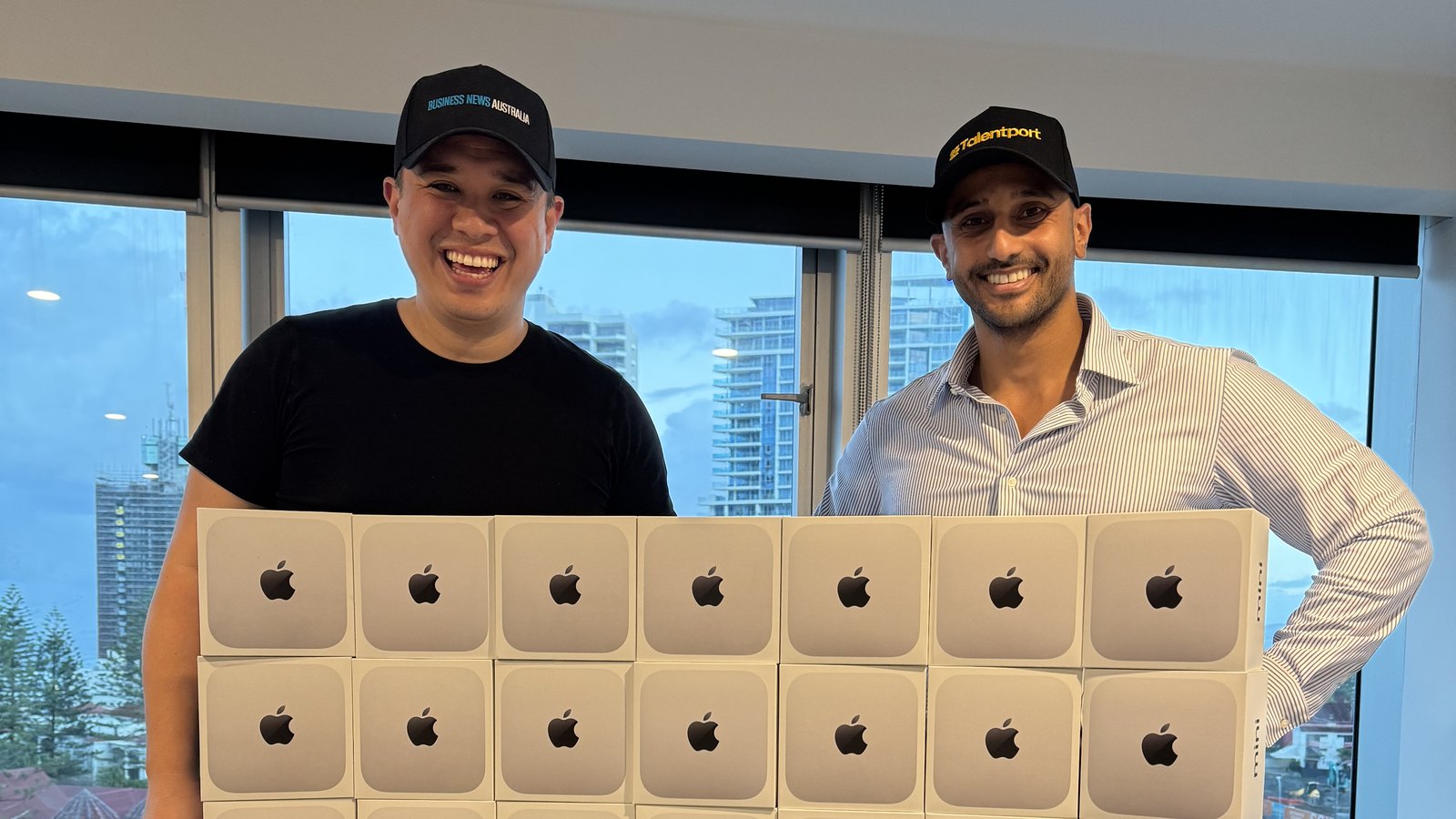
There's a photo of my Co-Founder and I grinning behind a wall of Mac mini boxes in our office. People think it's staged. It's not. We bought them by the stack, and every one of those boxes ends up as an AI assistant working inside an Australian business. I get asked all the time why we do it this way instead of just paying for ChatGPT like everyone else. Fair question. Here's the honest answer, both sides of it.
Quick translation first. Local AI just means the model runs on a computer you own, sitting in your office, instead of in a data centre owned by a tech giant. Same as the difference between files on your own machine and files on someone else's server. Both work. The question is what you're trading.
The case for the cloud
Cloud AI needs no hardware and no setup. You pay the monthly fee and someone else handles everything. The smartest models in the world live in the cloud, and the best ones you can run on your own gear sit a few months behind them. If you need the absolute cutting edge on every single task, the cloud wins that one. And if you barely use AI, keep your twenty dollar subscription. Honestly. I've told plenty of business owners exactly that. Using it twice a week? A box is overkill. Bank the difference.
Cloud also scales without you thinking about it. A hundred people hammering it at 9am on a Monday? A data centre soaks that up. One little box on a shelf can't.
The case for the box
Now the other side, and it's a longer list than most people expect. Data is the big one for me. With cloud AI, every prompt travels through someone else's computers. Your client list. Your financials. That awkward staff situation you asked it to help you word properly. Most of the time nothing goes wrong. But if you handle sensitive client information, most of the time was never the bar. On local hardware, none of it leaves the building. The National AI Centre found about 65 per cent of businesses that haven't touched AI point at distrust, or wanting to keep humans in control, as the reason. A vendor promising to behave doesn't fix that. A box you can physically unplug does.
Then there's the cost, and this is where it gets fun. Cloud AI is priced per person, per month, forever. In Australia the mainstream business options run somewhere between $30 and $45 a seat each month. Ten people? That's $4,000 to $5,500 a year, every year, and the price goes up whenever the vendor feels like it. A capable little machine is a one-off spend of one to two and a half grand, and it doesn't care whether three people use it or ten. Running costs are a joke. Apple's own numbers put a Mac mini at about four watts sitting idle, which works out to roughly fifty bucks a year in electricity. My rule of thumb: if you're spending more than $100 a month on cloud AI, a box pays for itself inside a year. After that you're in front.
It works offline too. It's quick, because nothing has to travel across the internet. And hiring an eleventh person adds exactly zero to your AI bill.
What this means for a small business
Here's where I'll stop being balanced, because for small businesses this is where it gets real. Most owners I meet are losing twelve to fifteen hours a week to admin. Reports built by hand. Invoices chased when someone remembers. Meeting notes that never get written up. Surveys of Australian workers using AI put the time saved at four to six hours a week, and in my experience that number jumps when the AI runs as a system instead of a chat window you have to remember to open. That's what the box changes. It doesn't wait to be asked. Ours build the sales report at 9am, draft the client follow-ups, prep my meeting briefs and flag the contacts I've gone quiet with. Every day. Nobody kicks them off. And because the box is a fixed cost, every new job you hand it makes the maths better. A subscription charges you per person. The box just works harder for the same fifty bucks of power.
The catches
It's not a free lunch, so here's the fine print. Someone has to own the box. Models need updating, backups need doing, and when it breaks at 7am someone has to care. A box nobody looks after becomes a very quiet paperweight. The capability gap is real for some work, though not for the repetitive jobs that actually eat an owner's week. And one machine is one point of failure, so you plan for that the same way you would for any other bit of gear in the business. That maintenance problem is exactly why AI Assist by Talentport works the way it does. The Mac mini sits in your office and belongs to you. We set it up, connect it to how your business actually runs, keep it updated and keep an eye on it. You get the control and the economics without becoming an IT department. That's the whole pitch. The wall of boxes in the photo is what it looks like in practice.
If you're weighing it up, three questions sort it out.
How sensitive is the data you'd hand over?
How many repeating jobs could it own?
And do you want a bill that grows with headcount or one that doesn't?
Answer those honestly and the decision usually makes itself. And if you want a second opinion, reach out. I'll give it to you straight, even if the answer is that a twenty dollar subscription is all you need.
Learn more here...
https://talentport.com.au/ai-assist