
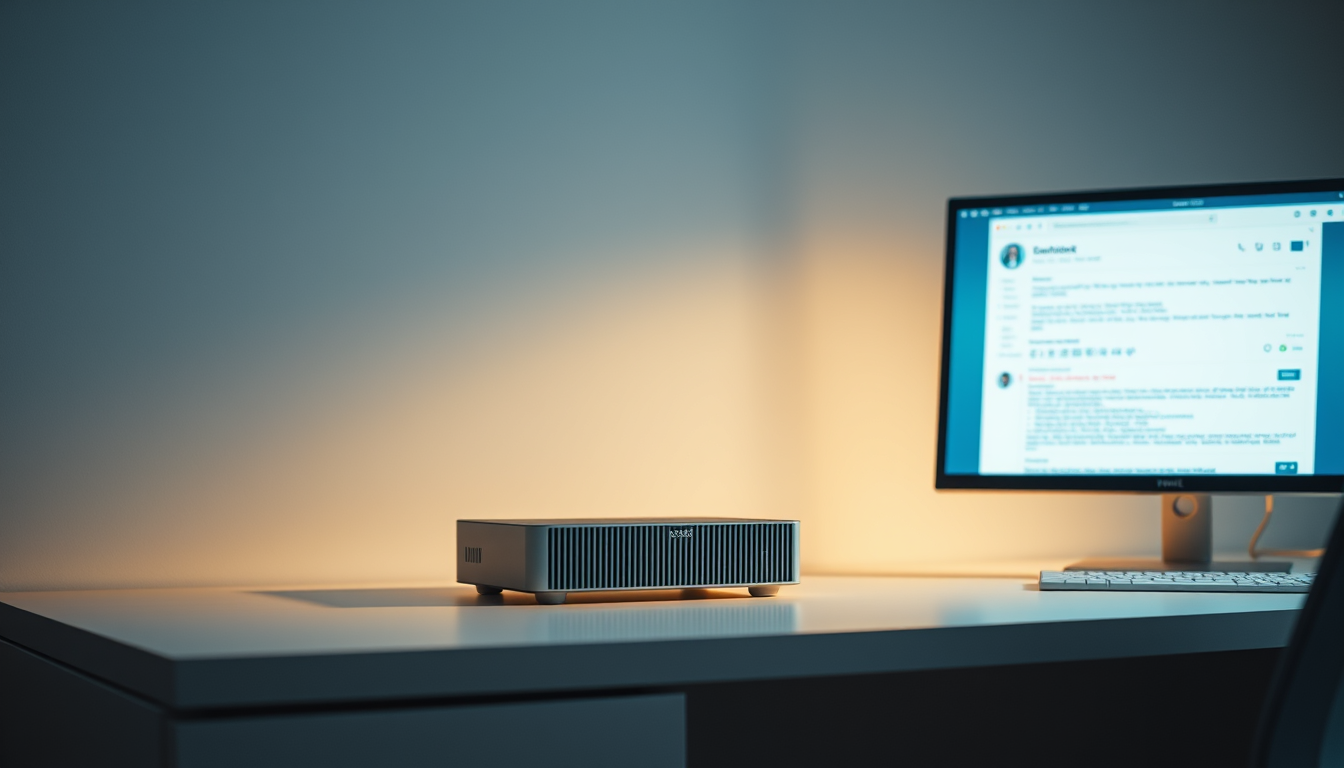
Every morning at 9am, one of my businesses I manage gets a sales report. It covers yesterday's invoices out of Xero, the call volumes off our phone system, and the numbers against the month's target. Nobody on the team compiles it. It arrives from an AI assistant with its own email address, and anyone in the business can read exactly what it sent and when. I want to talk about why that last part matters more than the AI itself.
The National AI Centre reports that 43% of Australian SMEs now use AI in some form. That leaves a majority who don't, and the reason is not cost or capability. Around 65% of non-adopters point to distrust of AI decision-making, or a desire to keep humans in control, according to the same National AI Centre research. Owners are not saying the technology is useless. They are saying they can't see what it's doing, so they won't hand it anything that matters.
That's a rational position. Most AI in small business today is either a chatbot bolted onto a website or a feature buried inside software you already pay for. It works in the dark. You don't know what it said to a customer, what data it drew on, or where the output went. When something is invisible, you either trust it blindly or you don't trust it at all. Most sensible owners choose the second option. So we flipped the model. Instead of hiding the AI, we made it work like a staff member you can see.
That's the thinking behind AI Assist by Talentport. The assistant gets a real email alias on your domain, the same as any new hire. It runs on a Mac Mini that sits in your office and belongs to you, not on some vendor's cloud you'll never inspect. And it does defined, recurring work: the daily sales report, the weekly client update drafts, the follow-up chase, the meeting prep brief. Every one of those lands in an inbox with a sent record attached. If you want to know what your AI did last Tuesday, you open its sent folder and read it and build a report that it sends you.
I run this in our own group of companies, and have for a while now. My assistant preps me before meetings, drafts client emails for review, flags contacts I've gone quiet with, and compiles reporting across several entities that used to eat someone's morning. The drafts are drafts. A human reads them before anything goes to a client. The reports are reports. I still make the decisions they inform. What's changed is that the repetitive layer of the business runs itself, visibly, with a paper trail. There's a principle underneath this that I've held for years: every task you do twice is a system you haven't built. The second time you compile the same report, chase the same overdue invoice, or write the same onboarding email, you are doing a system's job by hand. Small businesses are full of this work. It's not strategic, it's not creative, and it's exactly what a well-scoped AI staffer does reliably.
The productivity case is real. FlowWorks found that about 79% of AI users report productivity gains. My experience matches that, but only when the work is scoped properly. Which brings me to the honest part.
This is not magic. An AI assistant with an inbox does defined jobs, and it does them well precisely because they're defined. It won't run your business, read a room, or make the judgement call on a difficult client. It will occasionally need correcting, the same way a new team member does in their first month. A human still owns every outcome. In our setup the assistant only emails approved recipients, drafts sit for review before anything external goes out, and the owner can audit the lot. Those constraints are not limitations we apologise for. They're the design.
Transparency is the trust mechanism. Not a promise, not a compliance badge, just the plain ability to read everything your AI sends, on hardware you own, from an address you control. When owners can do that, the trust question changes from "do I believe the vendor?" to "do I like the work?" That's the same question you'd ask of any employee, and it's one small business owners are very good at answering.
If you're one of the 65% holding back, I don't think you're behind. I think you've been offered the wrong shape of AI. Ask instead what a transparent version would look like in your business: which report gets compiled by hand twice a week, which follow-ups slip, which inbox needs a steady pair of hands. Start there, keep it visible, and judge it the way you'd judge any new hire. That's how I did it. Happy to compare notes if you're thinking it through.